Lantern AI for Cambridge Primary

Plan less.
Teach more.

Plan, prepare, and mark with confidence in a fraction of a second. Lantern AI does the heavy lifting, you stay in control.

Framework codes on every question Answer keys stay teacher-only
40 papersgraded 12 hrs savedper week

Our mission

Give teachers their evenings back, and every child a consistent education.

Great teaching shouldn't mean late nights writing plans and marking papers. Lantern AI works with your curriculum to make the work behind great teaching faster and easier.

Framework-codedEvery objective carries its code.
Built with teachersShaped in real classrooms.
One threadPlan to report, never re-typed.
Teacher approvesNothing reaches a child first.

What we're building toward

0+ Hours back per teacher, each week
0× Faster than marking by hand
0 Stages covered today
0% Teacher-approved before a child sees it
Live Cambridge Primary Stages 1–6 · English, Maths & Science Next — Lower Secondary · IB PYP · IB MYP. Tell us what you need

Welcome to
Lantern.

01 — Plan

The plan writes itself.

Pick the subject, stage and unit. The plan arrives sectioned, framework-coded and printable — then steer it in one sentence, or refine a single section without disturbing the rest.

Objectives coded · print-ready

Plan type

Long-termShort-termAnnual

Stage

Stage 1Stage 2Stage 3 Stage 4Year 3Stage 5Stage 6

Subject

Science

Unit

Unit 6 · Electricity
  • Unit 1 · Living things
  • Unit 2 · Energy
  • Unit 3 · Materials
  • Unit 4 · Earth and its habitats
  • Unit 5 · Light
  • Unit 6 · Electricity
Whole unit (every lesson)

Lesson number

5

Guide the agent optional

Step 2 of 3 · this step is valid Generate plan

Drafting the plan…

Around 30 seconds

Working from Unit 6 — Electricity in your school's own Cambridge scheme of work and learner book.

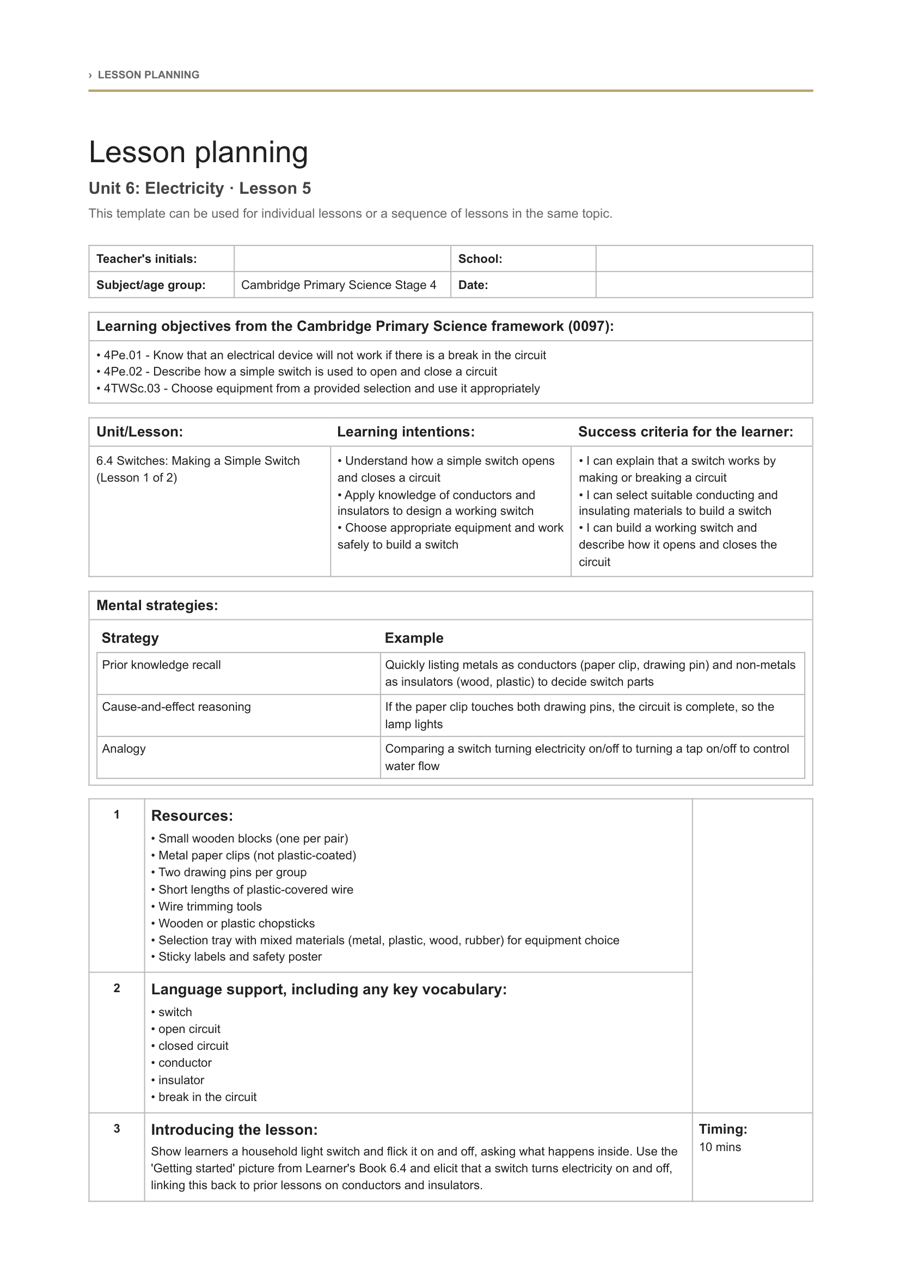
Lesson planning

Unit 6: Electricity · Lesson 5 — Cambridge Primary Science Stage 4

Learning objectives from the framework

  • 4Pe.01 Know that an electrical device will not work if there is a break in the circuit
  • 4Pe.02 Describe how a simple switch is used to open and close a circuit
  • 4TWSc.03 Choose equipment from a provided selection and use it appropriately

Learning intentions

Understand how a simple switch opens and closes a circuit

Success criteria

I can build a working switch and describe how it opens the circuit

Mental strategies

Prior knowledge recall Listing metals as conductors and non-metals as insulators to decide switch partsRefine
Cause and effect If the paper clip touches both drawing pins the circuit is complete, so the lamp lights
Framework-coded · print-ready

Science Stage 4 Unit 6 — Short Term Plan

Science Stage 4 Unit 6 Make a worksheet from this plan
SectionsFull plan

Select sections to change them together — or refine any one card on its own.

Before the lesson

+ SelectFramework objectives
  • 4Pe.01 — an electrical device will not work if there is a break in the circuit
  • 4Pe.02 — how a simple switch is used to open and close a circuit
  • 4TWSc.03 — choose equipment from a provided selection
Refine this Match framework wording Narrow to one focus
+ SelectSuccess criteria
  • I can explain that a switch works by making or breaking a circuit
  • I can build a working switch and describe how it opens and closes
Refine this Make them checkable Add one for the practical
Writing questions from this plan…

The plan it writes is a real export — read the actual paper below or download the PDF.
02 — Prepare

Build papers with one click.

Build tailored papers for any topic in seconds. Print instantly, or release digitally and let students submit online.

Objectives coded · AI-refine

Output type

WorksheetQuiz HomeworkRetrieval starter

Name

Unit

Unit 1 · Living things and their habitats
  • Unit 1 · Living things and their habitats
  • Unit 2 · Energy
  • Unit 3 · Materials
  • Unit 4 · Light
  • Unit 5 · Electricity

Question mix 12 questions

Fluency0
Reasoning0
Problem solving0

Demand

SupportCoreStretch

Add a constraint

EAL learnersNo printing Include answer keyGroup work
Step 2 of 3 · this step is valid Generate 12 questions

Writing the questions…

Around 30 seconds

Drawing from Unit 1 — Living things and their habitats in your Science Stage 4 learner book and past papers, matched to the mark scheme.

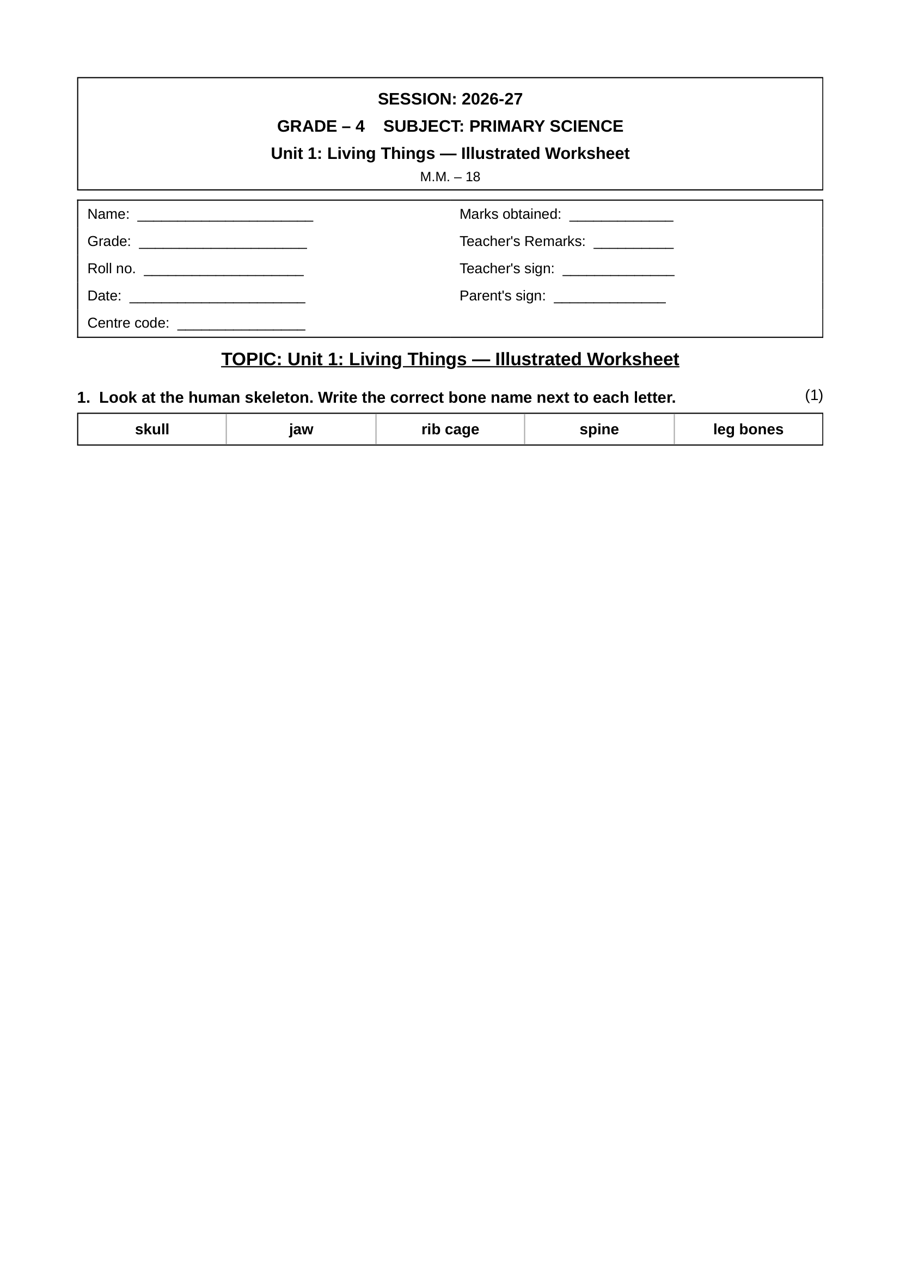
SESSION: 2026-27

GRADE – 4    SUBJECT: PRIMARY SCIENCE

Unit 1: Living Things and Their Habitats — Illustrated Worksheet

M.M. – 18

Name: Marks obtained:
Grade: Teacher’s remarks:
Roll no.: Teacher’s sign:
Date: Parent’s sign:

TOPIC: Unit 1: Living Things and Their Habitats

1. Look at the human skeleton. Write the correct bone name next to each letter.(1)

skulljawrib cagespineleg bones

a) A is the   b) B is the   c) C is the

2. Write True or False for each statement about skeletons.(1)

a) The skeleton protects soft organs inside the body.

b) Bones are soft and bendy.

c) The rib cage protects the heart and lungs.

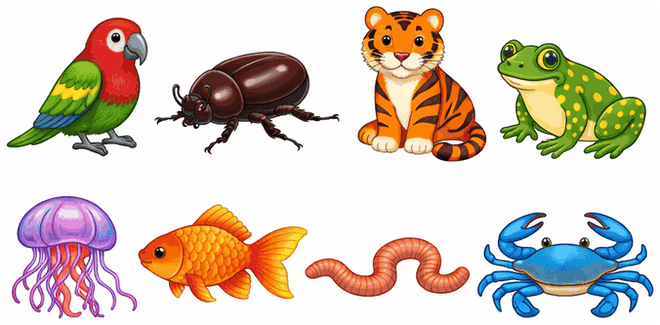
3. Look at the eight animals in the picture. Answer the questions.(2)

Eight animals: parrot, beetle, tiger, frog, jellyfish, goldfish, worm and crab.

a) Name two vertebrates from the picture.

b) Name two invertebrates that have an exoskeleton.

c) Which vertebrate group does the frog belong to?

4. Underline the correct word in each sentence about how muscles make bones move.(1)

a) When a muscle gets shorter we say it (contracts / relaxes).

b) Muscles always work in (pairs / groups of three).

Marks per question · figures drawn to match · answer key generated with it
Questions Full paper
Order changed Discard Save order
1Short answerUnit 63 marks

Read each statement about switches and circuits, then answer the questions.

Refine thisMake easierSwap question + Add after
2Short answer2 marksNew

Name a material that will not let the current through.

3Multiple choice1 mark

Which of these materials lets electric current flow through it?

4Diagram2 marks

Label the switch and the cell in the circuit below.

switch cell

Science · Stage 4 · Unit 6 — Electricity

Name ______________________ Class 4B · 14 marks · 30 mins

1. Read each statement about switches and circuits, then answer the questions. (3)

2. Name a material that will not let the current through. (2)

3. Which of these materials lets electric current flow through it? (1)

A copper wire   B plastic ruler   C wooden lolly stick   D rubber band

4. Label the switch and the cell in the circuit below. (2)

switch cell

5. Rana's torch stops working. Write two things she should check first. (2)

6. Explain why the bulb goes out when the switch is opened. (2)

7. Draw a circuit that would make two bulbs light at the same time. (2)

Exactly what prints — answer key on the next page.

Added a question after Q1

This paper exists — read the actual worksheet below or download the PDF.

03 — Mark

Grade with Lantern.

Scan and upload exam papers. Every answer is marked against Cambridge criteria, returning a fully graded class set in seconds.

Marks stay proposals until you publish
Desert-habitats-check_Kingfisher.pdf 28 pages
Alice Smith
Jamal Okafor
Mia Reyes
? page 7Rhea Kapoor
+ 24 more
28 of 28 pages matched to a name
DESERT HABITATS CHECK Name: Alice Smith  ·  24 Oct
Q1. Name two plants that live in the desert. Cactus and yucca. ✓ 1/1
Q2. Describe the desert climate. It is very hot in the day and cold at night. ✓ 1/1
Q3. Name two ways animals survive the heat. They hide in burrows in the day and they come out at night. ? 1/2 61% sure
Q4. Why does a cactus have a thick stem? To store water inside it. ✓ 1/1
Q5. Name one desert animal that comes out at night. The fennec fox. ✓ 1/1
5/6
0 answers it’s sure of
The other 25 wait for your eye.
171 sure19 nearly sure6 unsure

Waiting for you · least sure first +17 more

Q361% sureA. Smith · it says 1 of 2 Q364% sureJ. Okafor · it says 1 of 2 Q368% sureM. Reyes · it says 0 of 2 Q671% sureL. Chen · it says 2 of 3 Q574% sureN. Patel · it says 1 of 1 Q177% sureS. Ahmed · it says 1 of 1 Q479% sureH. Tanaka · it says 0 of 1 Q281% sureG. Müller · it says 1 of 2
Accept the 171 it’s sure of Start with the 25 →
Alice Smith — Desert habitats check script 4 of 28 · 6 questions
Q3. Name two ways animals survive the heat. They hide in burrows in the day and they come out at night. ? 1/2 ✓ 2/2
Q1Two desert plants1/1sure
Q2The desert climate1/1sure
Q3Two ways animals survive the heat unsure · 61%your mark
1/2
Scheme: any two adaptations, one mark each Why it stopped: it counted “hide in burrows” as one and wasn’t sure “come out at night” was a second.
Accept 1 Give 2 Type another
Q4Why a cactus has a thick stem1/1sure
Q5An animal that comes out at night1/1sure
Q6Where a desert plant keeps its water1/2nearly sure
5 of 6 marked · 1 waiting for you 6 of 6 marked · Q3 is your mark now
You touched one question of six · nothing publishes until you say so

Grading · Electricity end-of-unit

Reading 24 pages 0 done

Matched to your class list

Alice Mpage 1
Ben Cpage 2
Rhea Npage 3
?Name unreadable on page 7maybe Priyapage 7
22 of 24 matched — unmatched pages never hold the batch up Start marking 22 scripts

Electricity end-of-unit · 24 scripts · 168 answers

142 answers agree You only need to look at 26.

142 agree18 partial8 disagree
Accept 142 agreeing marks Review 26 flagged Publish 24 scripts

24 scripts returned — these marks are yours now, not the AI's draft.

Marking order
By questionBy student
One question across every script is faster and more consistent.
Question 4 · Why the bulb went out9 flagged

9 of 24 lost the same mark here — they named the switch but never the break in the circuit.

4Pe.01Stage 4 Science · 9 learners

Build a retrieval starter →Add a re-teach to a lesson →
Sam H61% Q4 · Partial · 2/3 Priya R68% Q4 · Partial · 2/3 Leo B44% Q4 · Disagree · 0/3

Science · Stage 4 · 12 Nov

Sam H — Electricity end-of-unit

← Back to all 24

Transcribed answersno scan uploaded for this script

Q3Which material lets the current through?"copper wire" Q4Why did the bulb go out?"the circuit breaks so no current" Q5Two things Rana should check"the bulb and if the wire fell off"
24 scripts published
04 — Report

See where every learner stands.

Grades roll into clear, per-learner, strand-level reports, showing which objectives each learner has mastered—and where they need more support.

Parent report drafts from the same evidence

Stage 4 · Kingfisher — Science

Autumn term · 0 learners · 0 assessments · 0 marked answers

Autumn
Where the class stands
0of 28
secure
18 secure 7 developing 3 emerging
Progress over time share of marks won
0%50%100% 71%
Mixed22 JulLiving things29 Jul Unit 61 AugDesert habitats4 Aug
By question, across the class the paper the Eye just marked
Q1 Q2 Q3 Q4 Q5 Q6
Q3 is where the class lost most — the same question the Eye kept flagging.

Alice Smith

Stage 4 · Kingfisher · Autumn term · 4 assessments marked

Objectives weakest first

4Pe.01 Know that an electrical device will not work if there is a break in the circuit Emerging
4Pe.02 Describe how a simple switch is used to open and close a circuit Developing
4TWSc.03 Choose equipment from a provided selection and use it appropriately Secure

Comment for parents drafted from the marks

Alice is working confidently when asked to choose equipment from a provided selection and use it appropriately4TWSc.03 · 7 of 8, and is still finding it hard to know that an electrical device will not work if there is a break in the circuit4Pe.01 · 2 of 6. [your note on how Alice works with others]

Underlined phrases are the marks · the bracket is yours to write

Class overview

Stage 4 — 4B

Autumn term 28 learners · 96 marked
Term
Autumn96Spring0Summer0
Subject
AllEnglishMathsScience

How the class is placed

Autumn term
64%

English

9 secure · 12 dev · 7 emerging

71%

Maths

13 secure · 10 dev · 5 emerging

58%

Science

7 secure · 9 dev · 12 emerging

SecureDevelopingEmerging centre figure = % of marks

Every learner

WeakestA–Z
  • LB Leo B3 marked · 5 objectives emerging Emerging
  • RN Rhea N4 marked · 2 objectives emerging Developing
  • SH Sam H4 marked · 1 objective emerging Secure
  • AM Alice MNothing marked this autumn term No marks

Objectives this term

most emerging first · Science
  • 4TWSc.03Choose equipment 2 emergingSecure
  • 4Pe.02Switches open & close 7 emergingDeveloping
  • 4Pe.01Break in a circuit 12 emergingEmerging
Weakest first: 4Pe.01 needs reteaching — next week's plan starts here. Plan a reteach →

Class · Every learner

Rhea N

2 of 28 · weakest first Write parent report
74%

English

Secure · 2 assessments

66%

Maths

Developing · 1 assessment

52%

Science

Developing · 1 assessment

Progress over time

% of marks, cumulative
100 50 0
EnglishMathsScience assessments in marking order

Objectives

weakest first
  • 4Pe.01Break in a circuit2 of 6 marks · 2 assessmentsEmerging
  • 4Pe.02Switches open & close5 of 8 marks · 2 assessmentsDeveloping
  • 4TWSc.03Choose equipment4 of 4 marks · 1 assessmentSecure

Home practice

from the family's Lantern tutor · beside your marking, never mixed in

4Pe.01 practised at home Tue 19:42 — the switch and the gap in the wire

4Pe.02 practised at home Sun 10:10 — building a working switch

Parent reports

Stage 4 — 4B · Autumn term

11 of 28 approved Export approved
Rhea NStage 4 · 4 assessments marked this term

Hover an underlined phrase to see the marked work behind it. Bracketed notes are yours to write.

Rhea has had a steady term in Science. She chooses her own equipment for an investigation4TWSc.03 · secure4 of 4 marks · 1 assessmentElectricity end-of-unit and can explain how a switch opens and closes a circuit. She is still working out why a break stops the whole circuit, which is where next term starts.

In Maths she works confidently with three-digit addition, and reads and writes numbers to 1000 without prompting. [add one thing you have noticed about Rhea this term]

Next term we will go back to circuits and give her more time building them by hand. [add what would help most at home]

Drafted from 6 marked objectives · 3 notes for you to add

ToneWarmPlainFormalEncouraging
RefineShorterMore detailFocus on progressAdd next steps
Mark as draft Next learner Approve & next
Approved — 12 of 28

See the actual output

Don't take our word for it — read the paper.

Unedited exports from the app. No sign-up, no email gate.

Page one of a generated Cambridge Primary lesson plan Click to preview
The lesson plan Framework objectives, learning intentions, success criteria and the lesson sequence — sectioned the way your school already writes them.
/Download PDF
Page one of a generated worksheet with colour figures Click to preview
The worksheet Questions from the activity books and past papers for your stage, with bright labelled diagrams that photocopy cleanly.
/Download PDF

Inside Lantern

Wait, that's not all.

Refine one question, a section, or the whole paper. Ask in plain words and Lantern rewrites only what you pointed at — even redrawing a figure — then shows you Current and Revised side by side before anything is saved.

Current | Revised, side by side Nothing saves without you Every draft, recoverable

Ask in plain words. She answers from your own classes and marking, and takes you to the right screen.

What's waiting for me today? Grounded in your classes ⌘J from anywhere

Electricity — end of unit check

Stage 4 · Science4B7 questions12 marks

Draft 1saved 09:12
3Short answer3 marks

Write two sentences about what happens when the switch opens.

4Pe.01 · a break in a circuit

4Diagram2 marks

Label the switch and the cell in the circuit below.

switch cell
5Multiple choice1 mark

Which one of these breaks the circuit?

A a longer wireB an open switchC a second cell

Click any question to aim the refine at just that one.

Revised Question 3"Make this more hands-on" drafted in 3s
Current

Write two sentences about what happens when the switch opens.

Revised

Build the circuit, open the switch — write down what you saw, and why it happened.

Swapped the written task for a build-and-test
3 marks, unchanged Still 4Pe.01 Still a short answer
Nothing is written to the paper until you save. Discard Save changes
Revised Question 4 — picture"Redraw it with the switch closed and the bulb lit" redrawn in 3s
Current

switch open · bulb out

Revised

switch closed · bulb lit

The picture was redrawn — check it still matches the question before saving.
2 marks, unchanged Labels kept Generated picture
Nothing is written to the paper until you save. Discard Save changes
Saved — Draft 2 · restore any time
Home ⌘ J

Wednesday · 4 March

Good morning, Ms Iyer
26flagged answers 2plans to sign off 17reports drafted
  • 4B · ScienceElectricityTuesday's paper marked
  • 5A · ScienceForcesPlan due Friday
  • 4B · MathsFractionsNothing waiting

Grading

4B · Electricity · Tuesday

28 learners · 16 questions · 26 flagged for you

  • Q4 · Rhea N.Partial · 2/361% sure
  • Q4 · Sam O.Partial · 2/358% sure
  • Q7 · Aarav P.Disagree · 0/244% sure

Reports · 4B

4Pe.01 — a break in a circuit

Weakest objective this unit · from Tuesday's paper

12 emerging9 developing7 secure

  • Rhea N.EmergingQ4, Q7
  • Sam O.EmergingQ4
  • Ivy L.DevelopingQ7

Parent reports

4B · Spring term

11 of 28 approved · drafts wait for you

  • Rhea N.Draft open6 objectives marked
  • Sam O.Drafted5 objectives marked
  • Ivy L.Approved7 objectives marked

The observation stays blank — that line is yours.

Plans · Friday 6 March

Electricity — circuits that stop

4B · 50 minutes · 4Pe.01, 4Pe.02

  • StarterReteach 4Pe.01 — find the gap, 10 min
  • MainBuild it, break it, explain it — 25 min
  • PlenaryTwo sentences on what stopped the bulb

Drafted by Lantern — needs your sign-off.

Ask Lantern

SeeingHome

What's waiting for me today?

Reading your marking queue…

4B · Electricity26 flaggedmarked Tue 09:04 Open Grading →
Which objective is weakest in 4B?

Reading 4B's marked work…

12 emerging9 developing7 secure Open the objective →
Draft Rhea's report for me

Checking what's marked for Rhea N…

Rhea N. · 6 objectivescan't write it yet Open Parent reports →
And Friday's lesson?

Reading Friday's plan…

Fri 6 Mar · 50 min4Pe.014Pe.02 Open the plan →
What's waiting for me today? Which classes do I teach?

Ask about your classes…

Our principles.

Grounded in Cambridge objectives

Every plan and question is written against the objectives for your subject, stage and unit, and carries its framework code — not fished out of the open web.

AI isn't the boss

We use AI to take the typing off your plate, not to replace a teacher's judgement about their own class.

You approve everything

Nothing is assigned, published or sent to a parent until a teacher says so. Marks are proposals until you publish them.

Nothing is a black box

A proposed mark shows the objective, the evidence and the reason behind it, so you can check it in seconds instead of taking it on trust.

Does it actually follow our scheme of work?

Yes — that's the whole design. Plans are generated against the board's own scheme of work for the subject, stage and unit you pick, and every plan and question carries its Cambridge framework code. If your school teaches from adapted or in-house materials, we can ingest those too.

Can I edit what it produces?

Everything. Plans refine section by section without disturbing the rest; worksheets can be re-levelled, re-ordered or swapped question by question. Every AI edit is a new draft, and earlier drafts stay restorable.

How accurate is the marking, really?

Treat it as a fast first pass, not a replacement for your judgement. Lantern transcribes each learner's handwriting question by question, marks against the scheme, and surfaces what it is unsure about rather than hiding it. Every mark is a proposal until you publish it, and your override always wins.

Where does student data live, and who can see it?

Scripts and marks stay attached to your school's account. Teachers see their own classes; nothing is pooled across schools, and student work is not used to train models. Full detail in our data & safeguarding note.

What does it cost?

We're running free pilots with a small number of partner schools while we build alongside real departments. Pricing after that is per-teacher, annual, quoted for your school.

Do parents need to buy the tutor for this to be useful?

No. Lantern · Teach is complete on its own. Lantern Link simply adds a home-practice card to a learner's report if that family independently uses the Lantern tutor and chooses to connect it.

Detail on where data lives, who can see it and how long it's kept: read the data & safeguarding note →

Who's behind Lantern

Built by engineers from the IITs

Lantern is built by IIT alumni who worked as software engineers at some of the world's largest technology companies — now focused on empowering both teachers and children.

Where our engineers worked before

Book a demo